Ballast Bonding and Ballast Stabilisation for Railways
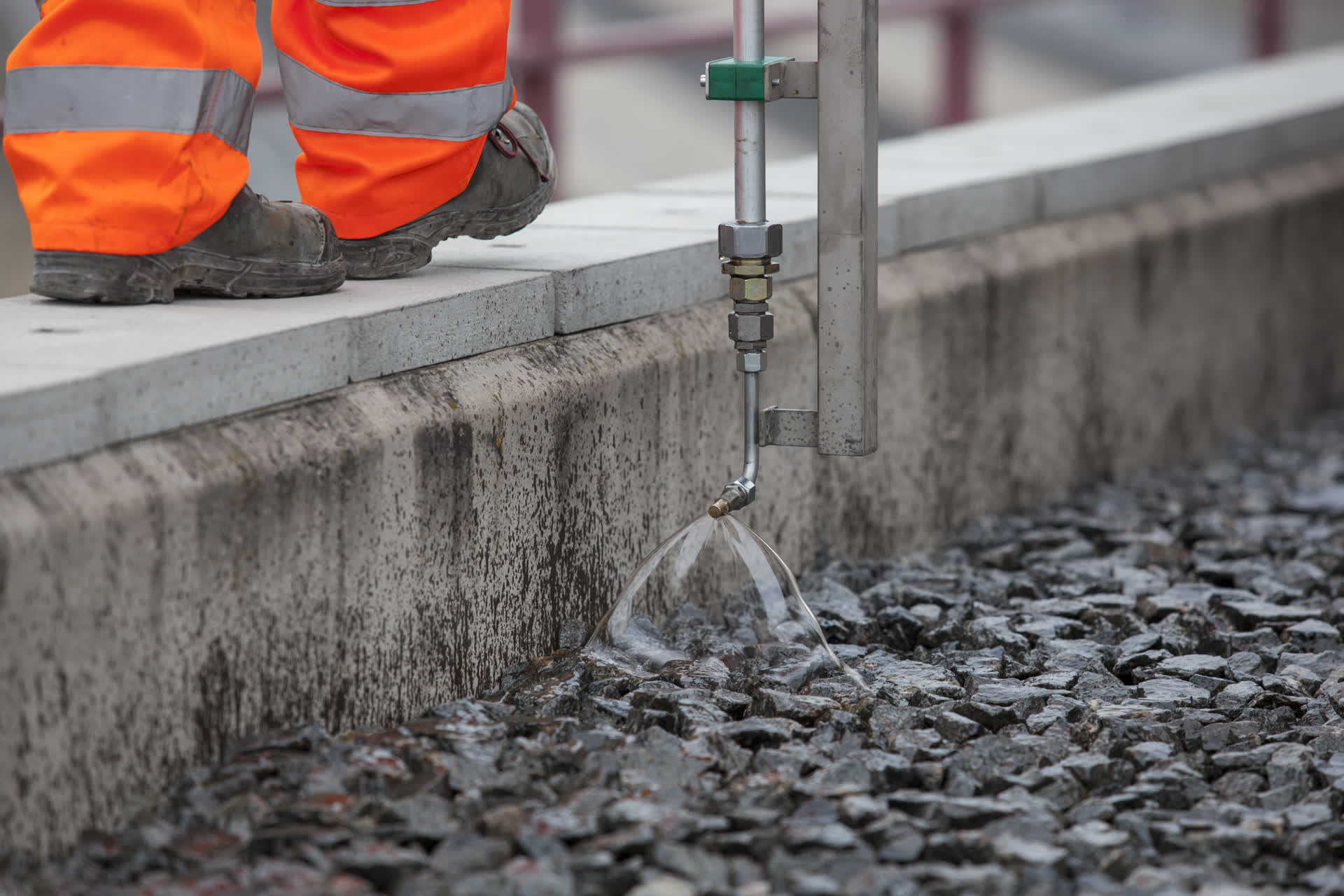
Terra System bonds track ballast by machine with the epoxy resin GREBOPOX® – to stop ballast flight, stabilise switches and transitions, and secure construction sites next to live track.
Request technical adviceAs one of the market leaders in structural ballast bonding, Terra System brings many years of railway experience. The system is approved by the German Federal Railway Authority (EBA) and is used by railways in Germany, Austria, Switzerland, France, the UK, Japan, Australia and Canada.
What is ballast bonding?
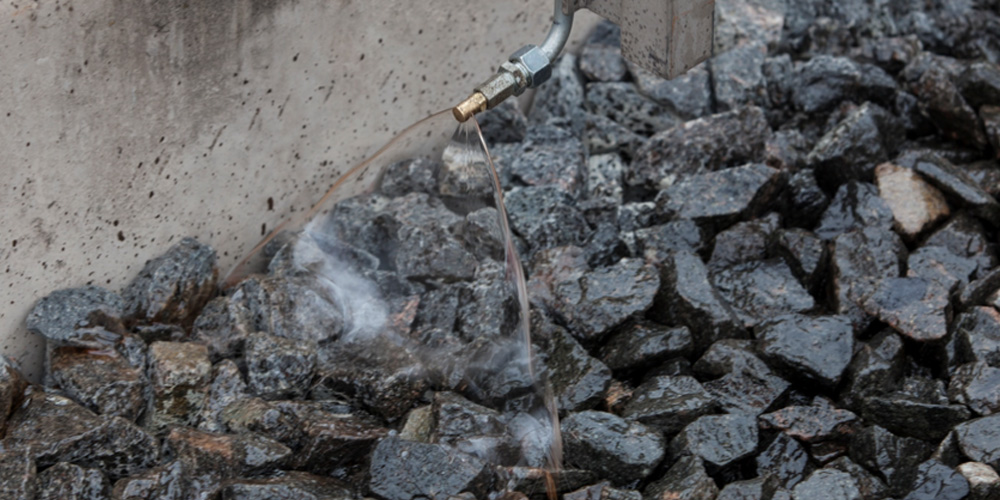
Ballast bonding applies a liquid two-component binder to the ballast bed. It joins the stones at their contact points without filling the voids. The ballast stays in place while water still drains freely. Depending on the task, only the surface, the ballast shoulder or the full depth of the bed is bonded.
Ballast bonding, ballast stabilisation and ballast consolidation describe the same principle.
Applications
Preventing ballast flight
At high speeds, especially in tunnels and on bridges, the suction of passing trains and falling ice lift ballast stones. They damage rails, rolling stock and equipment on the adjacent track. Surface bonding fixes the top layer of ballast permanently. Studies by DB, SNCF and JR have confirmed its effectiveness against ballast flight. The method is protected by patent.
Switches, insulated joints and lateral resistance
Higher speeds and axle loads put particular strain on switches, insulated joints and tight curves. Deep consolidation raises the lateral track resistance 8 to 10 times compared with conventionally ballasted track and considerably extends tamping intervals.
Transitions between ballasted track and slab track
At transitions, different stiffnesses and settlements meet, which drives up maintenance. Bonding that tapers off in steps – over 51 m, for example – evens out these differences. Transitions built in France were fully intact after eight years in service.
Securing live track next to construction sites
When the formation of an adjacent track is renewed, it lies about 1 to 1.5 m below rail level. Passing trains and compaction equipment can then set ballast rolling in front of the sleeper ends and reduce the lateral stability of the live track. Temporary bonding secures it.
Embankments and ballast shoulders
Bonded embankments and ballast shoulders are protected against erosion and slipping. Where there is no room for a full ballast shoulder in front of the sleeper ends, bonding still achieves the required lateral resistance.
Platforms, stops and escape routes
Ballast at stations and stops is often heavily soiled. Vacuum cleaning picks up loose stones and high-pressure cleaning displaces them. Surface bonding makes the ballast cleanable. Bonded chippings also create walkable escape and maintenance routes.
Protecting copper cables
A patented special method makes theft of copper cables in the track area much harder.
Preventing vegetation
Bonded surfaces keep UV light out of the ballast, so plants hardly take root. This is an alternative to chemical weed control.
Benefits at a glance
- The ballast bed stays fully permeable
- Better track stability, longer tamping and maintenance intervals
- High output, so possessions stay short
- Sound-absorbing, e.g. on urban transit lines
- Can be applied to damp ballast and in light rain
- Bonded ballast can be tamped, recycled and reused – no hazardous-waste disposal
- EBA approval for the German market
Method: machine application with two-component technology
Terra System works with mobile two-component hot-mix machines. Resin and hardener (amine) are brought to a constant temperature in the closed unit, mixed homogeneously and sprayed onto the ballast through nozzles suited to each application. The machine technology ensures an even, reproducible penetration depth.
| Penetration depth | up to 30–60 cm, depending on ballast grading |
|---|---|
| Working time | a good 30 minutes |
| Curing time | 3–6 hours |
| Application | from 2 °C, also on damp ballast |
| Machine output | approx. 5, 10, 25 and 30 kg/min (four units) |
Binder: GREBOPOX® by Gremmler
GREBOPOX® is an epoxy-based binder by Gremmler Bauchemie GmbH that tolerates residual moisture and was developed specifically for outdoor use. It can be applied from 2 °C and has fire class A2fl-s1 under EN 13501, which approves it for tunnel sections on DB lines.
Under an exclusive partnership, Terra System has used GREBOPOX® as its only ballast bonding resin since 2012. Gremmler manufactures the binder; Terra System plans and carries out the bonding.
Approvals and test results
- Approval by the German Federal Railway Authority (EBA)
- Standard construction method of Deutsche Bahn for several applications
- Fire classification A2fl-s1 under EN 13501, approved for tunnel sections on DB lines
- Long-term test over 125 million load tonnes – about seven years of service on an average track – with no damage to the bond
- Load tests at the Testing Institute for Transport Infrastructure of TU Munich: displacement tests at 90 kN, elastic deflection approx. 0.1 mm
- Quality management to ISO 9001:2015
Downloads and test reports
- Brochure: ballast stabilisation for railwaysPDF, 3,4 MB · in German
- GREBOPOX® fire classification report to EN 13501Exova Warringtonfire, Nr. 2005-1858-K1-1 · PDF, 100 KB · in German
- Test report: freeze-thaw and de-icing salt resistance of epoxy-bonded track ballastISFT Mendig · PDF, 950 KB · in German
- ISO 9001:2015 certificate – Terra System GmbHIT_ZERT, gültig bis 13.07.2027 · PDF, 90 KB · in German
How a project runs
- 1
Enquiry
Line, application, area or length, and the time window you have.
- 2
Technical review
Site visit or drawings, choice of method: surface, shoulder or deep consolidation.
- 3
Quote and planning
Matched to possessions and operations.
- 4
Execution
Machine bonding on site with our own equipment.
Ballast bonding FAQ
How long does curing take?
+
Working time is a good 30 minutes and curing takes 3 to 6 hours, so bonding fits into normal possessions.
At what temperatures can ballast be bonded?
+
GREBOPOX® can be applied from 2 °C. The heated mixing units keep resin and hardener at a constant temperature, which makes application easier at low air and ground temperatures.
Can you work in wet conditions?
+
Yes. The binder tolerates residual moisture and can be applied to damp stones and in light rain.
Does the ballast bed stay permeable?
+
Yes. The stones are only joined at their contact points and the voids stay open. Even heavy rain or high-pressure cleaning will not wash the ballast out.
Can bonded ballast be tamped or removed?
+
Yes. Bonded ballast can be tamped, recycled, reused or bonded again. No hazardous-waste disposal is needed.
Is the method suitable for tunnels?
+
Yes. GREBOPOX® has fire class A2fl-s1 under EN 13501 and is approved for tunnel sections on DB lines.
Do you work outside Germany?
+
Yes. The system is in use in Austria, Switzerland, France, the UK, Japan, Australia and Canada, among others.
All railway services at a glance: Railway track works at Terra System
Planning a ballast bonding project?
Tell us about the line, the application and your time window – we will come back with a technical assessment.
Request technical advice