Track Ballast: Structure, Function and Stabilisation of the Ballast Bed
Track ballast carries the track, holds it in position and drains water away. Learn how a ballast bed is built up, which problems arise in service and how ballast can be stabilised for the long term.
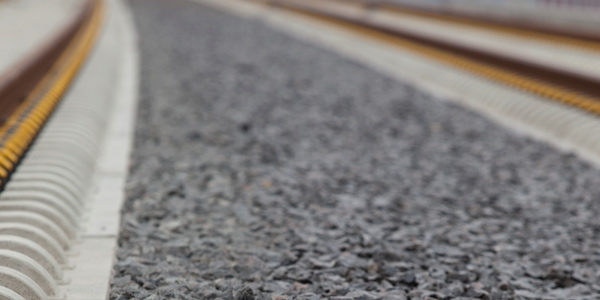
Ballast bondingTrack ballast is crushed hard rock on which the sleepers and rails of ballasted track rest. The sharp-edged stones interlock, spread the loads of passing trains over the subgrade and let rainwater drain quickly. Ballasted track is still the most common type of railway track worldwide.
What is track ballast?
Track ballast is made by crushing durable hard rock such as granite, basalt, diabase or greywacke. What matters is the particle shape and angularity: only sharp-edged, crushed stones interlock firmly enough to keep the track from shifting under load. Rounded gravel would not work.
In Germany, the 31.5/63 mm grading is standard for main lines. Requirements for railway ballast aggregates are set out in the European standard EN 13450.
How ballasted track is built up
From top to bottom, ballasted track consists of these layers:
- Rails and rail fastenings
- Sleepers made of concrete, timber or steel
- Ballast bed: under the sleepers, in the cribs between them and as a shoulder beyond the sleeper ends
- Formation protection layer of sand and gravel
- Formation, substructure and subgrade
What the ballast bed does
- Load distribution: spreads the forces of trains from the sleepers over a wide area of the subgrade
- Track stability: holds the track in position longitudinally and laterally (lateral resistance)
- Drainage: rainwater runs off quickly through the voids
- Elasticity: absorbs loads and dampens vibration
- Maintainability: track geometry can be restored by tamping
- Noise reduction: the open structure absorbs part of the rolling noise
Typical problems in service
Under constant traffic the ballast bed changes. Stones grind against each other, their edges round off and fines foul the voids. The bed loses bearing capacity and drainage, track geometry deteriorates and has to be corrected by tamping.
- Track geometry faults and settlement, especially at switches, insulated joints and tight curves
- Ballast flight at high speeds, caused by train suction and falling ice
- Differing stiffness at transitions between ballasted track and slab track
- Slipping ballast shoulders on embankments and during work on the adjacent track
- Fouled ballast at platforms that is hard to clean
- Vegetation growing in the ballast bed
Ballast bonding: stabilising ballast for the long term
Ballast bonding applies a two-component binder to the ballast bed. It joins the stones only at their contact points and leaves the voids open, so the ballast stays permeable but is secured against shifting and being lifted.
Terra System bonds track ballast by machine with the epoxy resin GREBOPOX® – against ballast flight, at switches and transitions, on embankments and to secure live track next to construction sites. The method is approved by the German Federal Railway Authority (EBA).
Track ballast FAQ
Why is there ballast under railway tracks?
+
The ballast bed spreads train loads over the subgrade, holds the track in position, drains rainwater and absorbs loads. Track geometry can also be corrected again and again by tamping the ballast.
Why is track ballast sharp-edged?
+
Only sharp-edged, crushed stones interlock firmly enough to stop the track shifting under the weight of trains. Rounded stones would slide against each other.
What size is track ballast?
+
In Germany, the 31.5/63 mm grading is standard for main lines. Requirements for railway ballast are set out in EN 13450.
What is tamping?
+
During tamping, track machines lift the track and compact the ballast under the sleepers with vibrating tamping tines. This corrects deteriorated track geometry.
What is ballast flight?
+
At high speeds, the suction of passing trains and falling ice can lift individual ballast stones. Flying stones damage rails, rolling stock and equipment. Surface bonding of the ballast prevents this.
What is the difference between ballasted track and slab track?
+
On ballasted track the sleepers sit in a ballast bed; on slab track they sit on a concrete or asphalt base. Where the two meet, transitions with differing stiffness need particularly frequent maintenance.
Can bonded track ballast be reused?
+
Yes. Ballast bonded with GREBOPOX® can be tamped, recycled, reused or bonded again; no hazardous-waste disposal is needed.
Stabilise ballast for the long term?
See how Terra System bonds track ballast by machine – applications, method and approvals.
Ballast bonding